 All stories


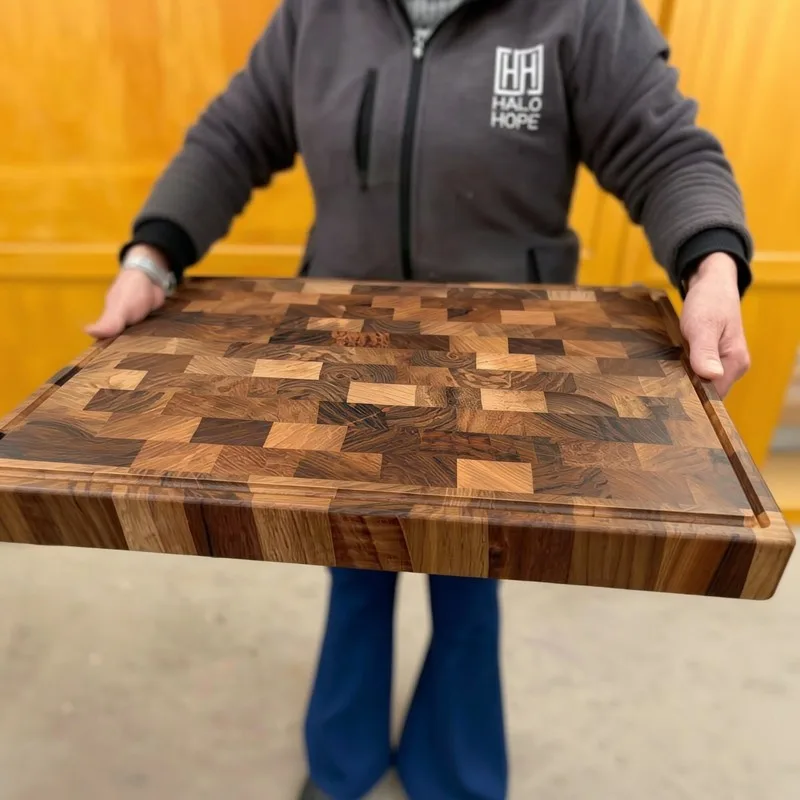
Somewhere in the listing for nearly every handmade cutting board is the phrase "finished with a food-safe oil," and that phrase is doing a lot of unexamined work. It might mean the board was soaked in food-grade mineral oil and is ready for a decade of daily chopping. It might mean it's wearing a glossy cured film that's perfectly fine for serving cheese and entirely wrong for a knife. The words look identical in both listings.
Buyers aren't wrong to hesitate. A good hardwood board is a buy-once kitchen object and one of the most-given wedding and housewarming presents there is, and the finish is the one part you can't judge from a photo. The vocabulary is small, though. Learn six or seven terms and every board listing becomes legible.
The Short Answer
"Food-safe finish" on a handmade board almost always means one of two things: a non-drying, food-grade oil — usually mineral oil, often blended with beeswax — that soaks into the wood and needs occasional renewal, or a finish that cures into a hard, inert film. Both are legitimate. The real question is use: oiled boards are for cutting; film-finished and epoxy surfaces are for serving. Ask the maker which face is meant for the knife, and expect to re-oil an oiled board for as long as you own it.
What "Food-Safe" Actually Means (and Doesn't)
There's no universal certification stamp that a finished handmade board carries, so "food-safe" on a listing is the maker's description, not a regulator's. That doesn't make it meaningless — it means you should look for the finish to be named, because named finishes can be evaluated and vague ones can't.
The most useful distinction in the whole subject is wet versus cured. A finish still curing — soft, still smelling of solvent — is a different substance from the same finish fully cured. The widely accepted rule among woodworkers is that common wood finishes, once fully cured, are inert and fine for incidental food contact; the practical differences between them are about durability under knives, water, and washing, not about danger. A board that arrives smelling of solvent is a curing problem to raise with the maker, not a reason to fear the category.
The Finishes You'll Actually See in Listings
- Food-grade mineral oil: the default, for good reason. It's a non-drying oil — it never hardens — so it penetrates the wood, repels water from within, and gets refreshed with a new coat whenever the board looks thirsty. It's flavorless and, unlike kitchen oils, doesn't go rancid — precisely why it's used instead of them.
- Board butter, or a wax finish: mineral oil blended with beeswax. The wax rides at the surface, adding water beading and a low sheen. Functionally mineral oil with a topcoat, maintained the same way.
- Tung oil: a drying oil pressed from the nuts of the tung tree; it cures inside the wood into a water-resistant finish. Pure tung oil is a classic on boards and bowls. One caution: many products labeled "tung oil finish" are blends with solvents and driers that need a full cure before food contact — worth asking a maker about by name.
- Walnut oil: another drying oil, popular with bowl turners for its warm tone. A household with a serious tree-nut allergy should ask what finish was used and default to mineral-oil boards.
- Varnish and "salad bowl" finishes: wiping varnishes that cure into a thin protective film. Cured, they suit serving pieces and display boards — but a film and a knife edge are natural enemies.
- Epoxy: the river of color down the middle of striking charcuterie boards. Fully cured, it's a hard, stable, wipe-clean surface suited to presentation — but not to cutting: knives score it permanently, and hot cookware can mark it.
Cutting Surface or Serving Surface? Decide Before You Buy
The decision framework is one honest question: what will this board do most days?
A daily cutting board wants an oil-and-wax finish, a plain working face, and enough thickness to stay flat for years. Every knife stroke on a film finish chips microscopic bits of that film loose and opens the wood beneath — so a glossy "sealed" surface marketed for chopping is the category's one true red flag.
A serving and charcuterie board flips the logic. It meets cheese and bread, not blades, so cured films and epoxy are fine, and looks are allowed to lead. This is also where engraving lives: a couple's name and date, a family recipe in a parent's handwriting. On personalized boards meant for real kitchen work, the convention is simple and worth confirming with the maker — engraving on one face, cutting on the other. Engraved grooves on a knife surface collect food and blur with every cut; kept to the display face, they stay crisp for decades, which is why engraved boards became a staple of wedding gifting.
A board that will mostly hang and serve occasionally can be either — buy that one for its face.
End Grain, Edge Grain, and What Each Asks of You
Edge-grain boards are long strips of wood glued side by side, fibers running horizontally, parallel to the surface. End-grain boards are the checkerboard ones: blocks stood on end so the fibers point up at the knife — like cutting into the top of a bundle of straws instead of across its side. That construction is gentler on knife edges, and it's why end grain is the traditional butcher-block surface.
For the buyer, the differences are practical. End grain drinks finish — the upright fibers wick oil, so a new end-grain board wants frequent oiling at first and stays thirstier than edge grain. It's also heavier, takes far more cutting and gluing to build, and is priced accordingly. Edge grain is lighter, more affordable, and a little more forgiving of neglect.
What to Look For (and What to Skip) in a Listing
Signs of a maker who knows the craft:
- The finish is named — "food-grade mineral oil and beeswax" tells you everything; "food-safe coating" tells you nothing.
- The wood species and the thickness are stated plainly.
- Care instructions ship with the board, or appear right in the listing.
- On an engraved or two-faced board, the listing (or the maker, when asked) says which face is for cutting.
- Construction is described — end grain, edge grain — and the price tracks it.
Reasons to keep scrolling:
- A glossy, film-finished, or epoxy-covered surface marketed as a cutting board.
- Painted or stained cutting faces.
- "Non-toxic coating" or "sealed" with no actual finish named.
- Filled cracks or voids on the working face — fine on rustic display pieces, not where the knife lands.
- Very thin boards sold for heavy daily use; thin hardwood is the first to cup and crack.
Where the Money Actually Goes
The finish is pennies of the price — what you're paying for is wood grade, labor, and construction. The entry tier is a solid edge-grain board in maple, walnut, or acacia: an honest daily workhorse. The middle tier buys thickness, better-figured wood, and engraving — the zone where most gift boards live. The heirloom tier is the large end-grain block: dozens of glued segments, serious weight, and a board that outlives its first owner if it gets oiled now and then. The catalog picks under this story sit along exactly this range — a useful side-by-side in how construction drives price. Across every tier, the maintenance contract is identical and cheap — soap, water, dry upright, oil when pale — which is part of why these boards keep their place among kitchen and dining gifts that actually get used.
Mistakes People Make
- The dishwasher. Heat and prolonged soaking are how wood boards crack and cup. Wash by hand with soap, rinse, dry standing upright.
- Oiling with olive or vegetable oil. Kitchen oils don't cure and eventually go rancid in the wood. Use food-grade mineral oil or a board butter; both are cheap and shelf-stable.
- Never re-oiling. A board that looks pale, feels fuzzy, or stops beading water is asking. Oil generously, let it sit, wipe the excess — ten minutes, a few times a year.
- Cutting on the engraved or epoxy face. Keep the knife on the plain face and the artwork stays sharp.
- Storing it flat and damp. A board left wet on the counter dries unevenly and cups. Upright, with air on both faces, every time.
Can I use olive oil to maintain a cutting board?
No — though it's the most common well-intentioned mistake in board care. Olive and other kitchen oils eventually oxidize and go rancid inside the wood, leaving a sticky surface and an off smell. Food-grade mineral oil is the standard because it's inert, flavorless, and never spoils. A mineral-oil-and-beeswax board butter does the same job with added water resistance.
How often should I re-oil a wooden cutting board?
Read the wood, not the calendar. When the surface looks pale or dry, feels rough, or lets water soak in instead of beading, it's time — for a new board that might be monthly at first, settling into a few times a year with normal use. End-grain boards drink more and ask more often. Apply oil generously, let it absorb for a few hours, then wipe off whatever remains.
Is it safe to cut on the engraved side of a personalized board?
It's safe, but it's a mistake. Knife work across an engraving blurs the design, and the recessed lines trap food and moisture, making the board harder to clean well. The convention makers follow is engraving on the display face, cutting on the plain face. If a listing doesn't say which is which, ask — a good maker answers immediately.
Are wood cutting boards hygienic compared to plastic?
A wood board washed in hot soapy water and dried upright has a long, well-earned place in serious kitchens — the drying is what matters most, since dampness is what microbes need. Plastic isn't automatically safer: deep knife scars in an old plastic board are genuinely hard to clean. Whatever the material, the rule doing the real sanitary work is separation — one board for raw meat, another for everything else.
Reviews & comments
See every public review for this Journal story and leave your own note.