 All stories


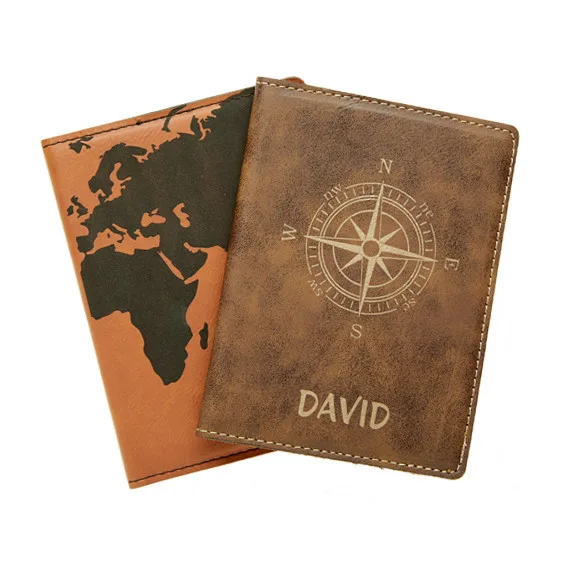
You can spot them at any departure gate: boarding pass clamped between their teeth, passport in one back pocket, phone at four percent in the other, patting themselves down for the card they had in hand ninety seconds ago. The half-packed traveler is not disorganized in the rest of life. Travel simply multiplies small critical objects — passport, cards, currency, tickets, chargers — faster than most people's systems evolve to hold them.
This is why most travel gifts fail: they add another loose object to the swirl. A gadget, a pouch, a clever cube — each one is something new to track. The travel accessory gifts that actually change someone's airport experience do the opposite. They subtract chaos by giving one existing critical object a fixed, findable home.
The Short Answer
Give a home, not another object. A leather passport cover with card slots, a slim travel wallet that consolidates the pocket-swirl, or a tag that makes an anonymous black bag identifiable are the three highest-yield choices. Prefer full-grain or top-grain leather and treat "genuine leather" as a warning label. Personalize with initials rather than a full name, keep the home address off anything visible, and treat RFID blocking as a bonus feature, not the reason to buy.
Organize, Protect, or Identify: Pick One Job
Travel accessories do one of three jobs, and the right gift is the one aimed at the pain you have actually observed in this person.
Organizers give scattered things a single home: passport covers with card slots, travel wallets sized for a passport plus cards and a boarding pass, small zip pouches that end the cable tangle. If your recipient is the gate-patter described above, this is their lane — and it is the lane most of the luggage and travel category serves.
Protectors defend what is already organized: structured cases for glasses and electronics, covers that keep a passport from fraying, wallets with shielding layers. These suit careful travelers whose gear shows wear, not chaos.
Identifiers make belongings findable: a distinctive luggage tag or strap that ends the carousel squint at a parade of identical black suitcases. Small, cheap, and disproportionately appreciated by anyone who checks a bag.
Then adjust for frequency. Frequent fliers feel every gram and every millimeter — for them, slim and durable beats feature-rich. Once-a-year travelers are better served by one consolidated travel wallet that lives in a drawer between trips, holding the passport so it never goes missing eleven months from now.
A Short, Honest Guide to Leather Labels
Most gifts in this category are leather, and the label vocabulary is designed to blur. Here is what the terms actually mean.
Full-grain is the outermost layer of the hide with the natural grain intact — the strongest part, and the only kind that develops a true patina, darkening and gaining character with handling for decades. Top-grain has been lightly sanded to remove imperfections; it is more uniform, still durable, and what most good accessories use. Both are honest materials.
"Genuine leather," despite the reassuring sound, typically means lower split layers of the hide, often coated and embossed to imitate grain. It is legally leather and it does not age gracefully. Bonded leather — shredded scraps pressed with adhesive — is worth avoiding entirely in a gift. PU or "vegan leather" is polyurethane-coated fabric: uniform, animal-free, and fine for some uses, but it will never patina and tends to crack as the coating ages.
The practical rule: a listing proud of its material names the grain. A listing that just says "leather" in large letters usually has a reason not to elaborate.
Personalization That Belongs on Travel Gear
Initials, debossed or engraved, are the sweet spot: personal enough to feel chosen, discreet enough for a security tray. Debossing — pressed directly into the leather — is permanent; foil-stamped monograms look sharper on day one and can wear at the edges over years of friction, so favor blind deboss on daily-use pieces.
What does not belong is the full name and home address on a visible luggage tag, announcing an empty house to anyone at the carousel. A first name with a phone number and email recovers a lost bag just as well. Personalization is also a commitment: a monogrammed item cannot be exchanged, so be certain of initials and style before you commit — order-of-initials conventions vary, and a quick check with someone close to the recipient is cheaper than a wrong guess pressed into leather.
What to Look For (and What to Skip)
Worth prioritizing:
- Grain named explicitly: full-grain or top-grain.
- Stitched edges rather than glued; stitching is the difference between aging and unraveling.
- Slim profiles — the accessory should disappear into a pocket or bag, not compete with its contents.
- Interior card slots in passport covers, which is what converts a cover from decoration into an organizer.
- Metal hardware on tags and straps; plastic buckles are where identifiers die.
Safe to skip:
- "Genuine leather" presented as a selling point.
- Bulky multi-pocket organizers that weigh more than what they hold.
- Any tag or cover displaying a full home address.
- Boxed sets of many small accessories; the recipient needed one home, not twelve.
- Foil monograms on pieces meant for daily friction.
Budget Reality
The entry tier gets you an embossed cardholder or a well-made identifying tag — small, useful, and complete as a gesture. The solid tier is where this category shines: a full-grain or top-grain passport cover or slim travel wallet, personalized with initials. Because price in leather goods tracks the grain and the stitching rather than the brand story, this middle tier is the genuine value sweet spot, and the pieces in it — like the catalog picks under this story — are the ones that live in a pocket for a decade. The heirloom tier means full-grain wallets, dopp kits, and bags built to patina over decades; spend here for the traveler whose current gear is already worn smooth, which is its own kind of compliment to the gift.
Mistakes People Make
- Adding an object instead of consolidating. The clever gadget becomes one more thing to lose. Fix: choose a gift that absorbs things they already carry.
- Buying by color and hardware instead of by grain. Fix: read the materials line first; if it does not name the grain, move on.
- Monogramming on a guess. Wrong initials cannot be exchanged. Fix: confirm spelling and initial order with someone close to the recipient before ordering.
- Putting the home address on the tag. Fix: first name, phone, email — that is everything a bag's finder needs.
Is RFID blocking actually necessary?
Contactless cards and modern passports do carry chips, and blocking layers — thin metal mesh or foil inside the lining — do prevent wireless reading. But documented real-world skimming of this kind is rare, and card networks carry fraud protections regardless. Treat RFID blocking as a low-cost bonus feature that adds no bulk, not as the reason to choose one wallet over a better-made one without it.
What is the difference between full-grain and genuine leather?
Full-grain is the hide's outermost layer with the natural grain intact — the strongest cut, and the one that develops a patina over years of handling. "Genuine leather" typically denotes lower split layers, coated and embossed to imitate grain; it is technically real leather but wears poorly and never improves with age. The gap between the two is the largest quality difference hiding behind similar-sounding labels in this category.
Should I personalize with initials or a full name?
Initials. They are discreet, they age with the piece, and they do not broadcast identity to strangers in an airport. A debossed two- or three-letter monogram reads as considered rather than labeled. Full names belong inside a wallet on a contact card, not on the outside of anything — and on luggage tags, a first name with a phone number and email does the recovery job without advertising who owns the bag or where they live.
Do passport covers fit all passports?
Standard booklet passports, including the US passport, share closely similar dimensions worldwide, so a standard cover fits nearly all of them. The practical variables are thickness and habits: a traveler who tucks several cards and a boarding pass inside needs a cover cut with slots and a little tolerance, while a tight minimalist sleeve suits the passport-only carrier. Check how your recipient actually carries theirs before choosing the style.
Reviews & comments
See every public review for this Journal story and leave your own note.